Guide to the World of Small Drones and How to Pick One
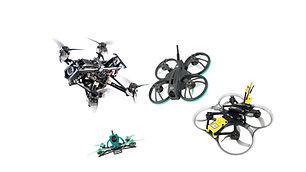
When people talk about “small drones”, they can actually be talking about several very different types of FPV drones.
You’ll hear terms like Tiny Whoop, toothpick, micro quad and cinewhoop — and then you have another decision to make: analog or digital FPV?
It can get confusing quickly, especially if you're looking to buy your first small FPV drone.
So let's break down the different types, what they're designed for, and how to choose the right one for you.
Tiny Whoop
Tiny Whoops are probably the smallest and most recognisable type of FPV drone.
They are usually around 65–75 mm and use propeller ducts that protect the small propellers. Most are powered by a 1S battery and are extremely lightweight.
Their biggest advantage is simple: they are hard to destroy and you can fly them inside of your house.
You can crash them into walls, furniture, trees and the ground and, in most cases, simply pick them up and keep flying.
Tiny Whoops are particularly popular for:
Indoor flying
Learning FPV
Racing
Flying in tight spaces
Lightweight freestyle
The downside is that they don't have much power. Even a moderate amount of wind can push them around, so they're much better suited to calm conditions or indoor flying.

Toothpick
Toothpick drones take the lightweight idea in a different direction.
Instead of using protective ducts, they normally have open propellers and an extremely lightweight frame. They are generally around 2–3 inches and are designed to get as much performance as possible from a very small amount of weight.
Think of a toothpick as the minimalist FPV drone:
Remove anything that isn't absolutely necessary.
This makes them particularly good for outdoor cruising, lightweight freestyle and flying through places where a larger 5-inch drone would be impractical.
The downside is that, without propeller guards, they aren't as forgiving around obstacles as a Tiny Whoop.

Micro Quads
“Micro quad” is a much broader term.
It generally refers to smaller FPV quads that don't necessarily fit neatly into the Tiny Whoop or toothpick categories.
They can range from around 2 inches to 3 inches or more and can be built for different purposes, including:
Freestyle
Racing
Cruising
Lightweight long-range flying
This is why the terminology can sometimes be confusing. There isn't one strict specification that makes a drone a “micro quad”.
Think of micro quad as the umbrella term, rather than a specific type of drone.

Cinewhoop
Cinewhoops are small FPV drones designed primarily for carrying a camera and capturing smooth footage.
They usually have ducts around the propellers and are larger and heavier than Tiny Whoops because they need enough power to carry additional equipment.
Common sizes include around 2–3.5 inches.
A cinewhoop can be used for shots that would be difficult with a conventional camera drone, flying through buildings, following people, moving through tight spaces or getting close to a subject.
The trade-off is weight.
A Tiny Whoop is designed around being as light as possible. A cinewhoop is designed around carrying a camera while remaining small and relatively protected.

Analog vs Digital
The type of frame is only one part of the equation.
Your FPV video system can also be either analog or digital.
Analog has been popular in tiny drones for years because the hardware is extremely small and lightweight. It's also cheap and has very low latency, which makes it particularly popular for racing.
The downside is obvious: the image quality is nowhere near modern HD digital systems.
Digital FPV gives you a much better image and a cleaner flying experience, but traditionally the hardware was too large and heavy for the smallest drones.
That's where things have started to change.
DJI O4 makes digital possible on smaller drones
DJI's O4 Air Unit weighs around 8.2 g including the camera and is designed to fit into much smaller FPV builds than previous generations.
This means you can now build a relatively small FPV drone with proper HD digital video instead of being limited to analog.
For larger micro drones, such as 2-inch platforms, this makes a lot of sense.
For something like a tiny 65 mm 1S Tiny Whoop, however, every gram matters. Adding an 8 g digital system to a drone that weighs only a few tens of grams is a very different proposition.
And for people already using DJI goggles and controllers, that's another major advantage of staying within the DJI ecosystem.
Small Drone Cheat Sheet
Type | Typical size | Main purpose | Biggest advantage | Biggest disadvantage |
Tiny Whoop | 65–75 mm | Indoor, learning, racing | Very light and durable | Limited power outdoors |
Toothpick | 2–3" | Outdoor cruising, freestyle | Extremely lightweight and efficient | Open props are less forgiving |
Micro Quad | 2–3"+ | Freestyle, racing, cruising | Versatile | “Micro” covers a wide range of builds |
Cinewhoop | 2–3.5" | Cinematic footage | Small camera platform | Heavier and less agile |
Analog FPV | Any size | Racing, lightweight builds | Cheap, light and low latency | Lower image quality |
Digital FPV | Any size* | General FPV, cinematic flying | HD video and better image | More expensive and usually heavier |


Comments